In which your average Jane works to eat, live, and become more environmentally and socially friendly.
Showing posts with label environmentalism. Show all posts
Thursday, October 20, 2011
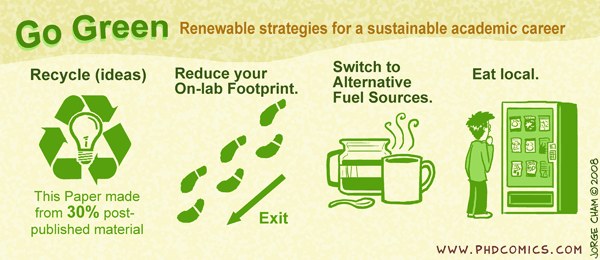
Graduate Greening Tips
Thursday, September 8, 2011
See Jane Bike to Work
I've finally got my dream commute. I now live two miles from my school/work, instead of thirty!
Since gas is expensive and time to exercise has been getting scarse, I've taken my repaired bike and put it to good use. Before heading out, I asked around for some advice. Redditor wirehead has been biking for a long time in both urban and rural environments, and had some great advice for me, the novice biker:
| Image from Treehugger |
First off, he believes that people are more capable of biking than they think. 60% of trips are within five miles, and the average, out-of-shape person can handle that without too much hassle. I'd be concerned about hills if I'm still building muscle, but over flat ground, small errands won't be an issue. Panniers are helpful for doing real errands. I'm not using this idea yet as I'm still conquering the hill outside my apartment, but it's something to think about. People don't realize that the risks of cycling are not as bad as you'd expect. I've noticed that, while I have to pay attention still, people are fairly courteous if you drive close to the edge of the road, obey traffic signs, and use your hand signals. But no one is happy if you ride on the sidewalk and speed through stop signs. Just don't.
When factoring in the time difference between cars and bikes, he reminds new bikers to figure in parking. It's quite easy to park a bike, but hunting for car parking takes longer and often involves walking to your destination afterwards. I can park my bike in front of every building I need, which is awesome on a college campus where most parking is a shuttle ride away. Use Google Maps' biking directions to see if there are shortcuts for bikers, and don't forget that using a bus can be a good way to get around tough spots.
Friday, June 17, 2011
Simple Solutions
Sometimes the answers to our climate, ecology, and health dilemmas are shockingly simple. I wanted to highlight one such innovation.
Going green is more than just the things that you and I need. We are lucky enough to live in a country that consumes too much, to the point where we must practice scaling back. But it's easy to forget that many people live in areas without electricity, reliable healthcare, and clean water. Those are often the people who need our help as environmentalists.
If we can help them, we help our planet. Why? We got into a massive environmental mess by having to innovate with only what we had at the time. Some trace much of the issue to the industrial revolution. If we re-engineer the way we use resources, we can fix problems. However, if we help give these solutions to people who haven't had the problems yet, we can help developing nations avoid these problems in the first place.
But first, we have the fundamental problems to fix. One such solution I found in my internet readings really hit home how simple solutions can work best. Solar Disinfecting (SODIS) has come up with a cheap, clever way for killing the water-born bacteria which cause intestinal disease in many poor nations. How? By filling 3-liter plastic bottles with the water, and putting it on the roof in the sun for six hours. The heat and UV radiation kills the bacteria and makes it safe to drink. It doesn't take fancy machines, and one woman they trained is making forty bottles of clean water a day. She chills them and sells them as a way to increase her income.
Clean water reduces infant mortality and increases community health. It's essential for human survival. This is my favorite sort of innovation to fixing a survival problem. It doesn't require fancy machinery. It doesn't require chemicals. It doesn't require anything but plastic bottles. Even the bottles are reusable once the water is consumed.
When we environmentalists sit around thinking of ways to fix the world's problems, it may seem that it's overwhelmingly complicated. But inventions like this show us, it's the little things that can fix big problems. We in the industrialized nations should consider this in our own greening attempts. It's not necessarily the solar panels on your roof but rather the tomatoes on your back porch which make the biggest difference.
Subscribe to:
Posts (Atom)