Showing posts with label anthropology. Show all posts

Tuesday, February 15, 2011

Eco Snobbery Sucks

This is my opinion on environmentalism. I'd actually never heard of it before I read about the eponymous website  (found here), but once I'd heard about it, I was appalled.

The website itself is a fun read. It's lighthearted and informative, especially if you want to find out how even Sith Lords are planning to go green. But the root of the author's point is clear.
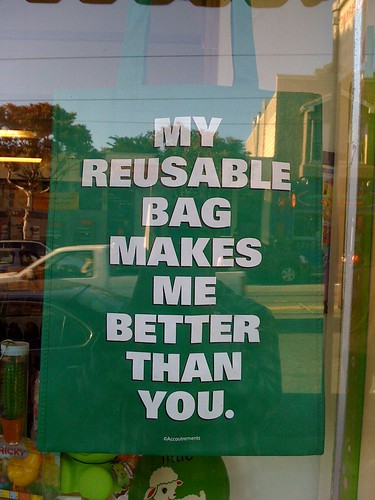
Image copyright Tyrus Smalley
I think that eco snobbery is the worst thing that environmentalists can do to create sustainable ecological change. It leads to a false dichotomy - either you're saving the planet by biking to your yurt in your vegan sneakers while wearing only certified organic cotton tie-dye clothes or you're throwing aluminum cans out the window of your your Hummer while driving two blocks to McDonalds in order to pick up your Big Mac. Given the choice to work, strive, and spend a lot of money to still be told they're falling short, or to throw up their hands in disgust and not care about anything any more, I'm sure most people choose the latter. Either way they're the villains in an eco-snob's view, so why should they bother?

I'm sure you can see why this is environmentalist kryptonite. Eco snobbery undermines our entire platform by making the very people we seek to reach (or become) not willing to listen to a word we say. Instead of being an eco snob and pointing out all the flaws in someone's environmentalist efforts (or your own, for that matter), celebrate every step of the process. Shortened your showers? Drove less? Ate vegetarian for a week? Congratulations! Whoop it up and give yourself a gold star on the calendar. Messed up? Take a page from Scarlett O'Hara - tomorrow is another day. Hear that someone tried something new to go green? Congratulate them, no matter how small the step seems to you. If they're talking about it, they're obviously proud of their efforts, so don't spoil it for them.

How do you keep yourself on the eco track? Do you have a "go green" buddy, who you can swap tips and share accomplishments? Do you write a blog, like me? Suggestions always welcome in the comments. 

Tuesday, September 14, 2010

How not to be a "trendy" conservationist.

My conservation class had a detailed discussion about this subject. Is it a good thing that being ecofriendly has become so popular? We came up with two different perspectives.

One is the good - people are thinking (however slightly) about their environmental impact. They use metal water bottles, eat from farmer's markets or buy organic, buy a Prius instead of a Hummer, and recycle. Basically, it's a start to true environmentalism and sustainable living.

The down side is that environmentalism becomes trendy, and suddenly it's a cliche selling point. "GREEN!" screams each and every semi-recycled, maybe-not-as-good-as-it-claims product. Yahoo! has a list of "Signs of a green hypocrite" that is worth a read. It's not ground breaking, but it's a start to make people think. Mainly it lists things like "people who use reusable bags but still eat meat at every meal", or "takes an eco-vacation but flies there, and first-class to boot".

Sustainable living shouldn't be a fad. It should be a way of life. Fads come and go, but true lifestyle changes stay with us. The hardest part for most people is making sure that the changes are feasible for their life, not the Grapefruit Diet of environmentalism. Sure, you lose C02 weight while you're on the bandwagon, but as soon as you fall off, you gain it all back again. But watching your C02 calories, decreasing your intake of single-use products, and cutting back on your oil, you've got a lifestyle plan that you're able to retain for years.

Make the changes fit your life, not vice versa. If you love bottled water, then get a reusable bottle and a charcoal filter. If you love new clothes, go to a thrift store and donate things when you no longer want them. If you love meat (like me!) then don't give it up entirely, but become a Sunday carnivore.  Life is about balance. Give being green a high priority, but make sure you can handle the change without resentment.

Most importantly, if you're going to talk the talk, whatever your particular environmental issue is, be sure you're walking the walk first. I surprised a friend when we headed to a mall and I made a purchase. I asked for no bag and whipped out my trusty furoshiki.
"You're sure serious about this whole environmentalism thing, aren't you?" She asked.
"Of course I am," I replied. "How can I recommend things on my blog if I don't do them myself?" As Gandhi said, be the change you wish to see in the world (otherwise, who will follow?).

Sometimes we slip. It's inevitable. I forgot my furoshiki when I changed purses and had to get two grocery bags just the other day. To use a cliche, sustainable living and environmental living are marathons, not sprints. You can bet exactly what went into my purse when I went home. That's green living, long term, not short-term.

Tuesday, July 6, 2010

Why You Should Care About Global Warming

A 2009 poll said that nearly 30% of all Americans don't believe global warming and climate change are happening or that it affects are overstated. This is a catastrophe. But this isn't the point of the blog. Let's assume, for writing sake, that you do trust that global change is happening. That you watched "The Inconvenient Truth", or that you've read "Dire Predictions" by Mann and Krump about the findings of the International Panel on Climate Change. Let's even assume you're skeptical about the how drastic the changes will be. 

Let me try to convince you that you should care. 

Assume the predictions are true. Assume that the polar ice caps and the Greenland ice sheet will eventually melt because of temperature rises of 2-3 degrees (three times that in the poles), that snowlines will rise at least 600 feet and that sea levels will rise about 12 feet or up to 21 feet.  Let's assume that severe storms like Katrina will increase nearly 50%, that there will be more fires (if you live in California, that should give you pause), and that oceans will sour and acid rain will increase. Let's assume that the growing season will shift and that our growing lands will become more susceptible to pests like the boll weevil and our cities to mosquitoes with malaria and West Nile. Let's assume that the frozen methane under the sea and the Siberian permafrost melts as temperature rises, since it's 23 times more destructive than carbon dioxide. 

Why should you care?


Saturday, May 8, 2010

On anthropology and ecology

I interviewed a few friends for an anthropology paper I wrote last quarter, and a couple of them have asked to read the final draft. The first who read it was quite impressed, but ended the conversation with "But, I always think that you're a scientist!"
Annoyed, I replied with my usual riposte: "I am a scientist. I'm a social scientist."
He countered his statement: "Oh, I meant a real scientist."

This frustrates me. The social sciences have gotten a rep as being full of "and how does that make you feel?" conclusions, and anthropology is especially prone to this. No one stands up for our discipline, either.

I think this needs to change. I think anthropology got kind of scared, honestly. The social sciences were used to justify a lot of really awful things in the past, like social Darwinism (hint: Darwin never said "Survival of the fittest".) and the Nazi genocide of pretty much everyone who wasn't Aryan. We got scared and shut up because we realized how powerful our words are, so we're scared to say anything that could cause more trouble, pain, or even death.

I understand this, and I agree with this. But times are changing. We live in a global village, but the problem is, we don't speak the same language, literally or culturally. I think that, as we come into contact more and more with other people who aren't Westernized, the social sciences, the study of these people and of us, is going to be more and more useful as a translator. If we don't understand other cultures, how can we urge them to conserve wildlife? Imposing our worldview on them doesn't create any change, it just creates resentment.

I'll be posting in more detail from my conservation bio class about a park called Amboseli in Kenya which has successfully used anthropology to create change. But this rant is about my discipline, and how the social sciences get pretty well dissed. I know we're a young science. Physics has been around for hundreds of years. Actual scientific study of humanity, society, and culture has only begun to form in the last hundred, and true scientific method in the last fifty.

 I can't get discouraged, though. My work needs to be meaningful, and I think the best thing we, as social scientists, can do is to remember to be careful. Learn from our history and mistakes, and act as guides when we can. Science alone is heartless and only interested in how things function. It's the social sciences which situate it in context, put the human back into the machine.